
In the rarefied world of high-end travel, true luxury is no longer defined solely by gold taps or thread counts. Today, the ultimate status symbol is access to the pristine, the untouched, and the rare. It is the privilege of standing in a silence so profound it rings in your ears, broken only by the wingbeat of a creature found nowhere else on earth.
Peru offers this exclusivity in abundance. It is a kingdom of geography, a vertical world that stretches from the Pacific surf to the icy diadems of the Andes, before plunging into the emerald abyss of the Amazon. Within this dramatic theater lives an aristocracy of the air: the Peruvian birds.
For the discerning traveler, the observation of Peruvian birds is not a mere pastime; it is a foray into a living art gallery. With over 1,800 registered species, this nation is the curator of one of the planet’s finest biological collections.
This is not a journey for the masses. It is an expedition for those who appreciate the nuance of evolution and the sheer extravagance of nature. In this guide, we invite you to discover the seven winged sovereigns that rule these skies. We will explore how to witness them in absolute comfort, ensuring that your pursuit of Peruvian birds is as refined as it is adventurous.
The Canvas of Evolution: Why Peru?
To understand the prestige of this destination, one must look at its canvas. No other country offers such a condensation of climates. The Andes do not just divide the country; they create a kaleidoscope of micro-worlds.
In a single day, a private charter can take you from the arid coastal desert to the cloud forests—the “eyebrows of the jungle.” It is here, in these transitions, that biodiversity explodes.
The Peruvian birds have adapted to these extremes with an elegance that defies logic. They are the jewels in the crown of South American wildlife. For the luxury traveler, this means that every lodge, every private trek, and every river cruise offers a front-row seat to a different evolutionary performance.
When you invest in a journey to see Peruvian birds, you are witnessing the result of millions of years of genetic refinement. It is a spectacle of color, sound, and survival that makes the human world seem pale by comparison.
1. The Andean Cock-of-the-rock: The Neon Monarch of the Cloud Forest
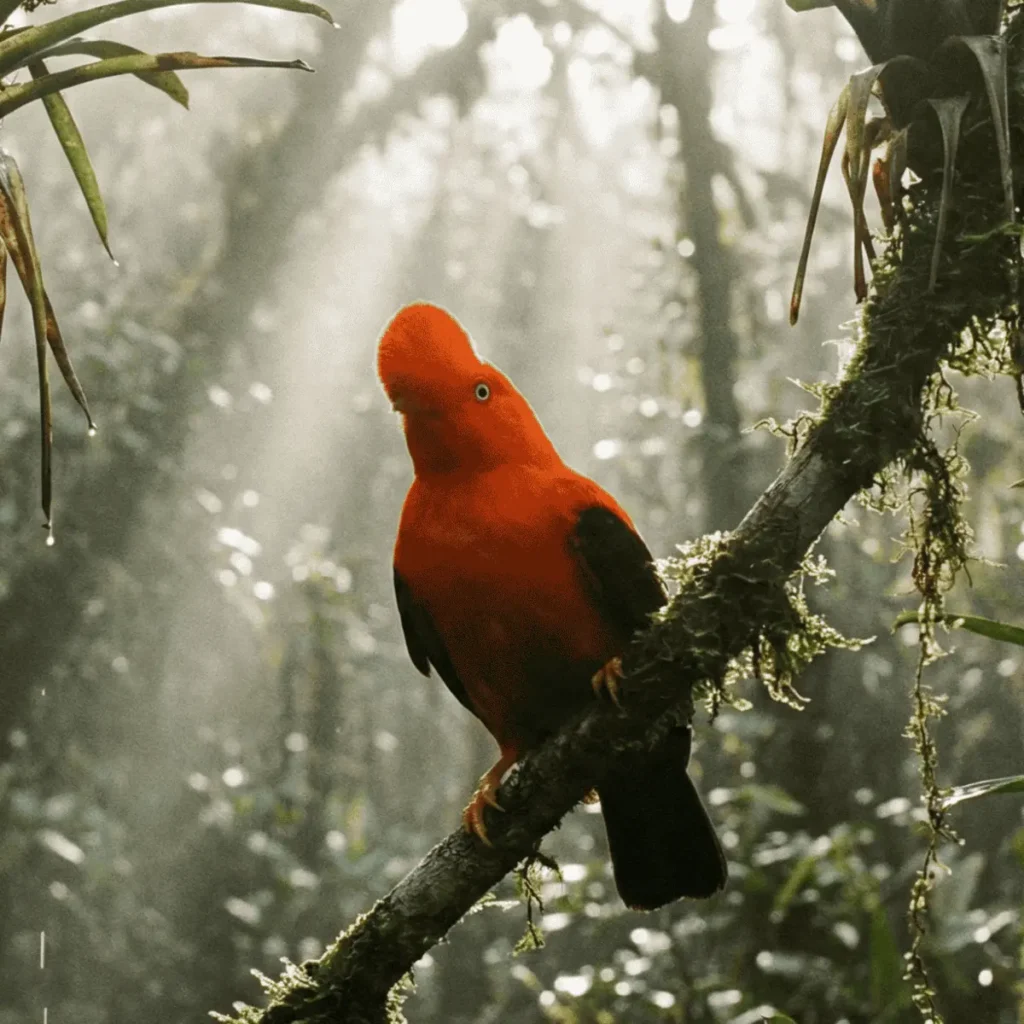
Deep within the misty verdure of the cloud forests—places like the private reserves surrounding the Inkaterra Machu Picchu Pueblo Hotel—lives a creature of startling opacity. The Andean Cock-of-the-rock (Rupicola peruvianus) is the national bird, but it carries itself with the haughty demeanor of a royal heir.
A Spectacle of Seduction
The male of the species is a masterclass in flamboyance. His plumage is a shock of neon orange or blood-red, a color so intense it seems to vibrate against the dark green backdrop of the jungle.
However, the true exclusivity lies in witnessing the “lek.” This is the avian equivalent of a high-society ball. Males congregate in specific clearings, transforming the forest floor into a stage. They bow, hop, and emit guttural calls, a competitive dance designed to woo the discerning females. Observing these Peruvian birds in their private courtship is a privilege reserved for the patient few.
The Luxury Experience
Viewing Peruvian birds like the Cock-of-the-rock does not require roughing it. High-end lodges in the cloud forest offer private guides who know the location of these leks intimately.
Imagine waking up in a suite suspended in the canopy, enjoying a gourmet breakfast of local tropical fruits, and then taking a short, private walk to a viewing platform. There, with high-definition optics in hand, you watch this ancient ritual unfold, undisturbed by crowds. It is an intimate audience with nature’s aristocracy.
2. The Andean Condor: The Emperor of the Hanan Pacha
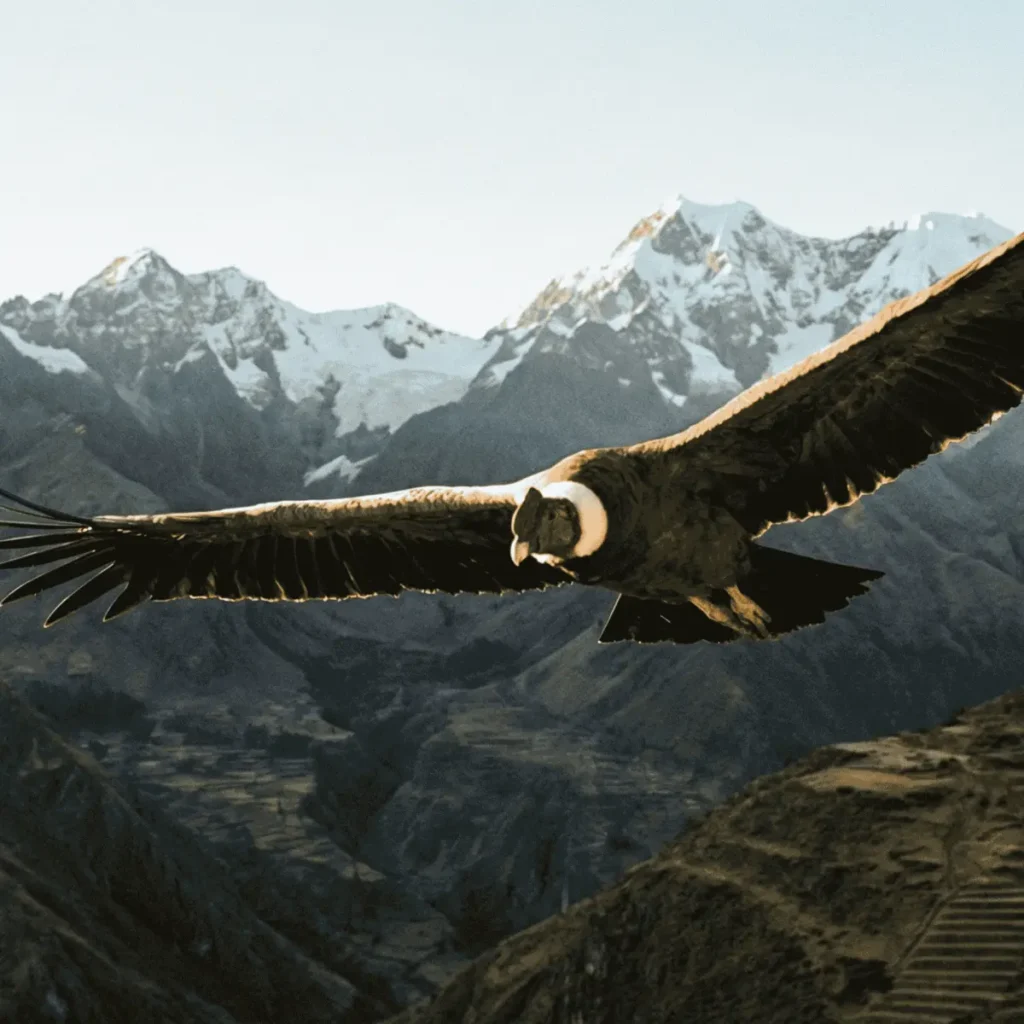
If the Cock-of-the-rock is the artist, the Andean Condor (Vultur gryphus) is the sage. In the cosmology of the Incas, the world was divided into three planes, and the Condor was the ruler of the Hanan Pacha, the superior world of the skies.
Engineering Perfection
To see a Condor is to witness a marvel of biological engineering. These are among the largest flying birds on Earth, with wingspans that command the wind itself. They do not flap; they glide. They are the masters of thermodynamics, utilizing thermal columns rising from deep canyons to ascend to heights of 5,000 meters or more.
Among all Peruvian birds, the Condor evokes the deepest sense of reverence. Seeing one soar over the Colca Canyon is a spiritual experience. It is a reminder of the scale of the Andes and the resilience of life in high altitudes.
Private Canyons
The standard tourist bus to Colca is not for you. The luxury approach involves a private driver and a stay at a property like Belmond Las Casitas. From here, you can arrange a private viewing at the Cruz del Condor before the masses arrive, or better yet, trek to secluded vantage points known only to local experts.
Sipping a glass of champagne on the edge of a canyon that is twice as deep as the Grand Canyon, while the shadow of a Condor passes over you, is the definition of a premium travel moment. It is the ultimate way to appreciate these massive Peruvian birds.
3. The Marvelous Spatuletail: The Sapphire of the North
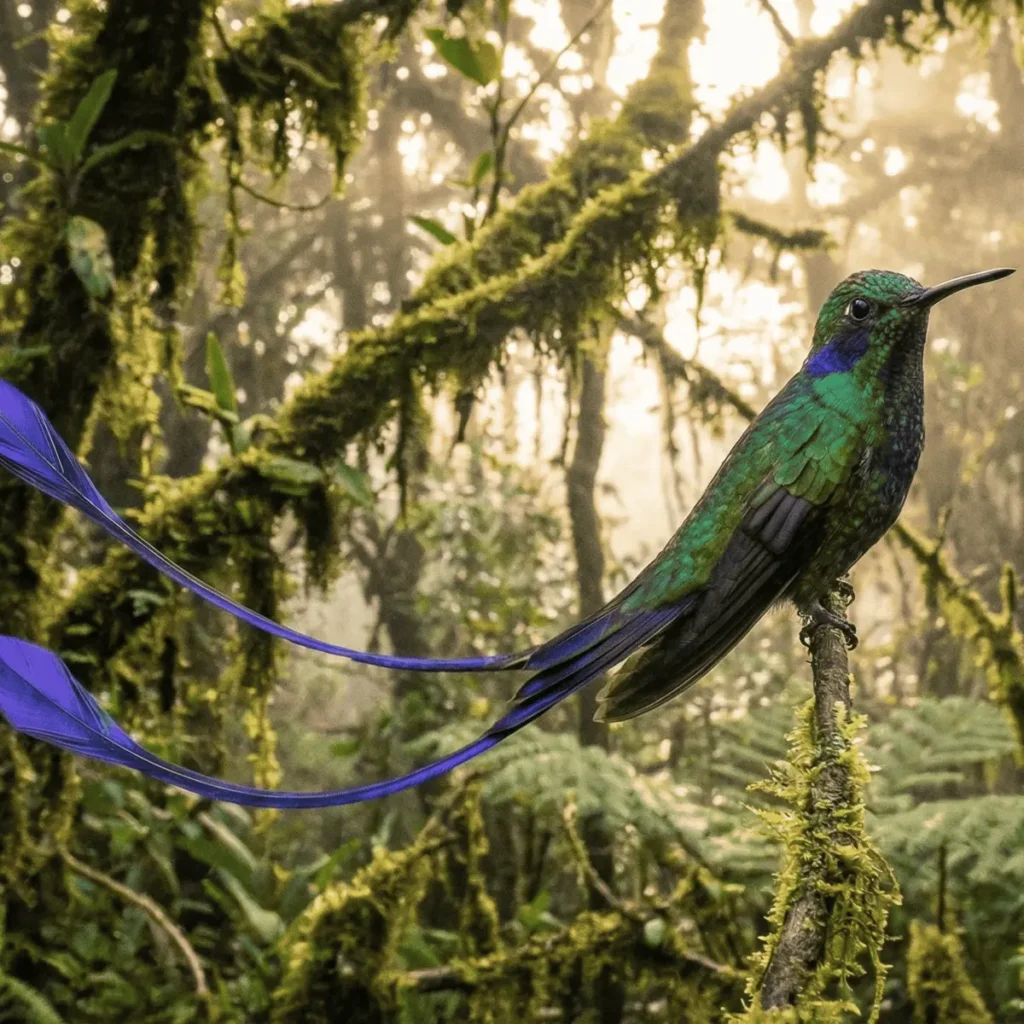
For the collector of rare experiences, the northern regions of Amazonas offer a prize that few have seen. The Marvelous Spatuletail (Loddigesia mirabilis) is the Holy Grail of hummingbirds. It is endemic, meaning it exists nowhere else.
The Impossible Geometry
Unlike other Peruvian birds, this bird is a defiance of physics. The male possesses two tail feathers that are comically long, ending in violet-blue spatules or discs. He can move these feathers independently, a feat that requires immense muscular control.
During his courtship display, he hovers in mid-air and whips these spatules around in a frenetic dance. It is a display of such speed and iridescent beauty that it feels like a hallucination. Of all the Peruvian birds, this small hummingbird is perhaps the most exclusive sighting.
Accessing the Remote
The Utcubamba Valley is remote, but accessibility is improving for the elite traveler. The experience here is one of rugged luxury. You are far from the beaten path, in a land of pre-Inca fortresses like Kuelap.
Staying in boutique haciendas near the Huembo Reserve allows you to support vital conservation efforts while enjoying the tranquility of the high jungle. It is a chance to see a creature that creates a buzz in the ornithological world, all while enjoying the solitude of the northern Andes. Seeing such rare Peruvian birds in the wild is a memory that lasts a lifetime.
4. Macaws: The Technicolor Lords of the Amazon
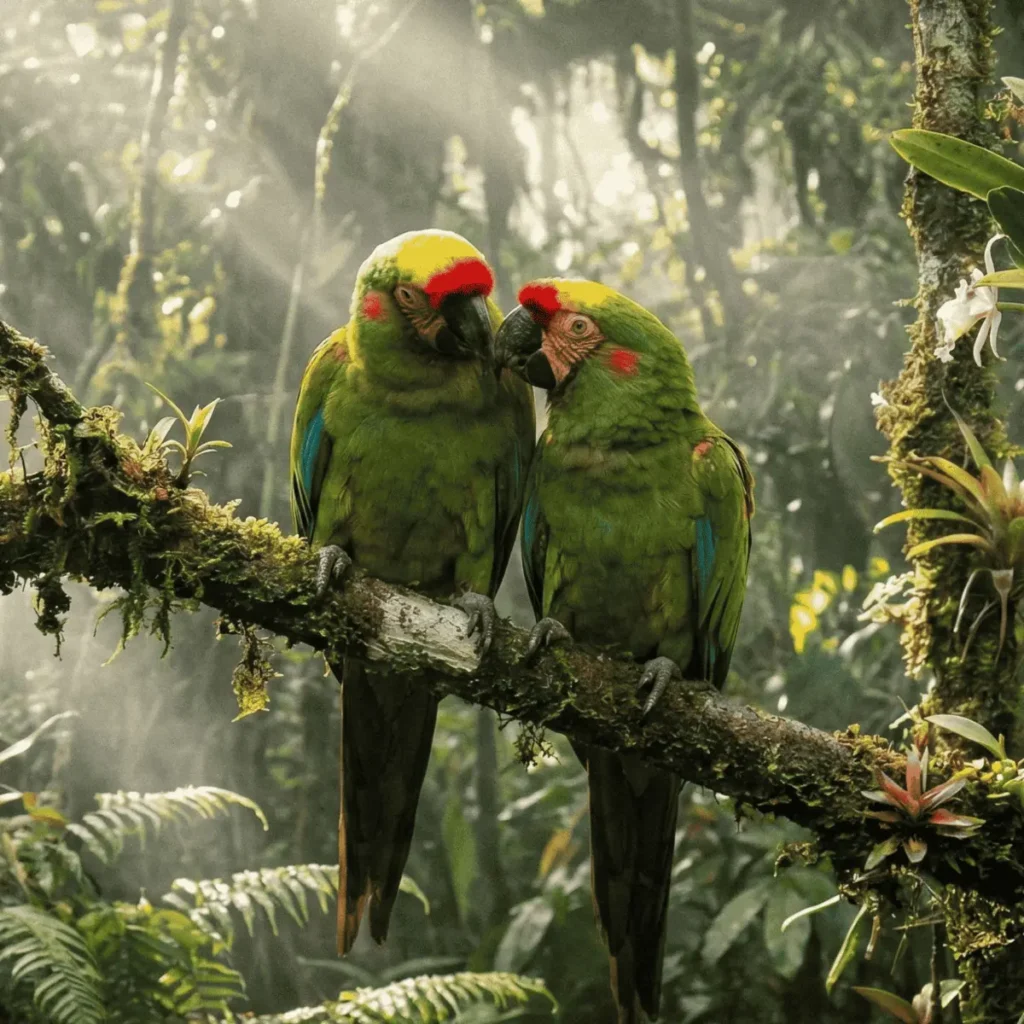
When one pictures the Amazon, the image is invariably painted in the primary colors of the Macaw. The Scarlet Macaw (Ara macao) and the Red-and-green Macaw are the charismatic megafauna of the rainforest canopy.
The Clay Lick Phenomenon
While seeing a macaw fly overhead is common, the true luxury experience is the “collpa” or clay lick. In reserves like Tambopata or Manu, these massive parrots gather in the hundreds at dawn to consume mineral-rich clay from riverbanks.
It is a riot of sound and color. The air fills with the screeching of curious parrots and the majestic, heavy flight of the macaws. It is a sensory overload, a reminder of the sheer abundance of life in the tropics and the diversity of Peruvian birds.
The River Cruise Perspective
To see these Peruvian birds in style, one should eschew the rustic backpacker lodges for a luxury Amazon cruise, such as those operated by Delfin or Aqua Expeditions.
Imagine drifting down the Amazon River in a suite with floor-to-ceiling windows. You explore the tributaries on private skiffs with expert naturalists, complete with chilled towels and refreshments. You witness the clay lick spectacle, then return to the ship for a lunch prepared by a world-class chef using Amazonian ingredients. This is the synthesis of comfort and wildness.
5. The Andean Flamingo: The Pink Elegance of the Altiplano
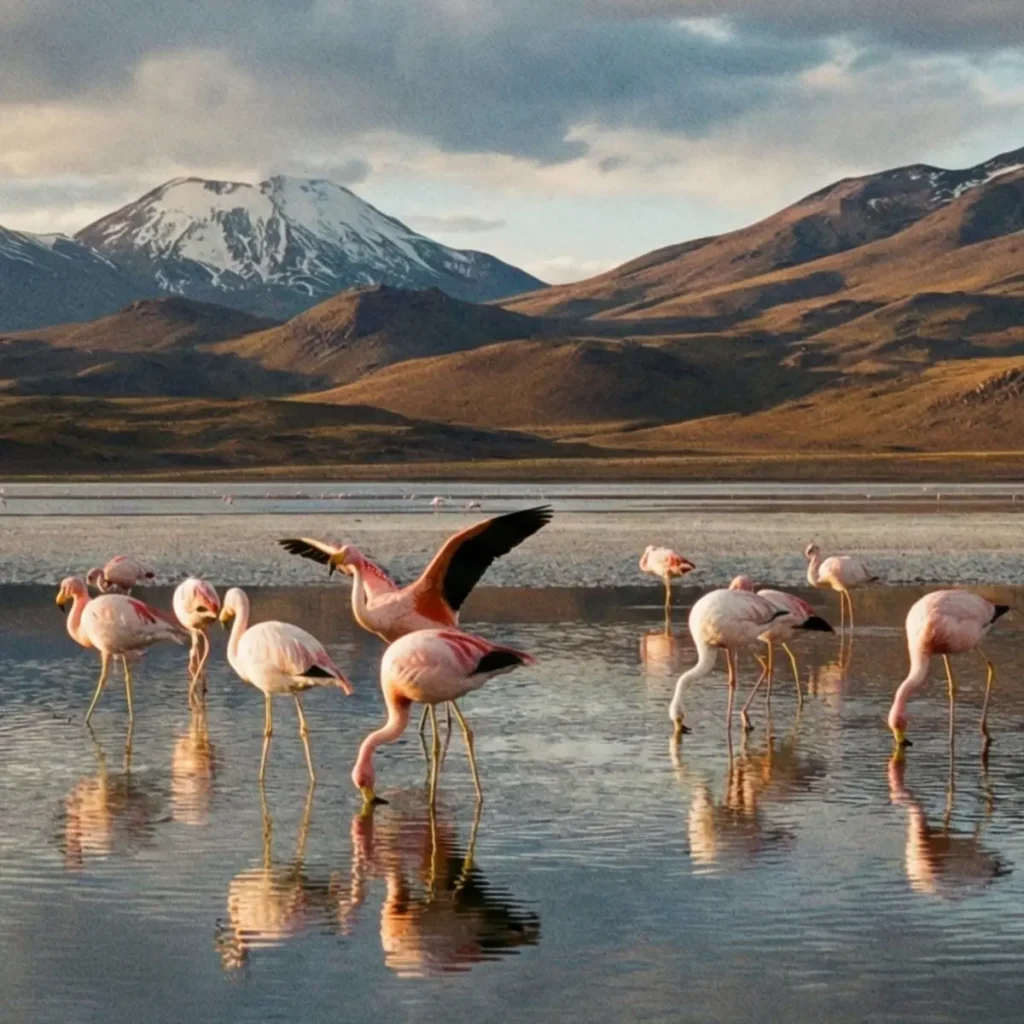
Far from the tropical heat, in the thin, crisp air of the high Andes, lies a landscape that resembles the surface of Mars. Here, amidst volcanoes and salt flats, stands the Andean Flamingo (Phoenicoparrus andinus).
A Study in Contrast
The visual impact of the flamingo in the Andes is striking. The stark, mineral tones of the mountains—ochre, rust, and grey—are suddenly interrupted by thousands of strokes of pink and white.
These Peruvian birds are survivors. They inhabit the bofedales (high-altitude wetlands) and saline lagoons, filtering microscopic life from freezing, alkaline waters. Their elegance is deceptive; they are among the toughest creatures in the highlands. Few Peruvian birds can claim such resilience in such a hostile environment.
The High-Altitude Retreat
Visiting the habitat of the flamingo often involves a journey to Puno or the high reserves of Arequipa. For the luxury traveler, the Titilaka Lodge on the shores of Lake Titicaca offers the perfect base.
From there, private excursions can take you to the remote lagoons. There is a profound serenity in watching a flock of flamingos mirror-imaged in a glassy lake, with snow-capped peaks in the distance. It is a photographer’s dream, a composition of light and color that is uniquely Peruvian.
6. The Torrent Duck: The Master of the Whitewater
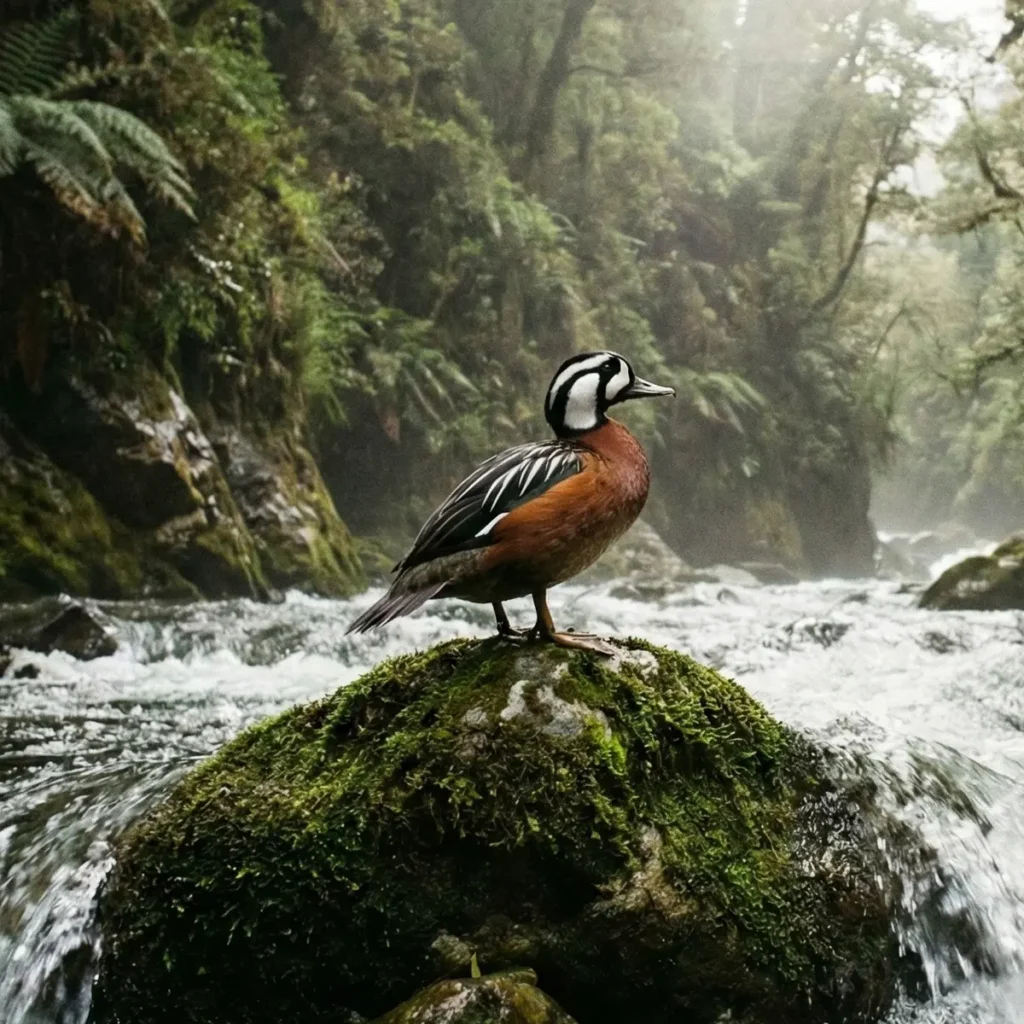
While the Flamingo represents stillness, the Torrent Duck (Merganetta armata) represents kinetic energy. This is a bird for the connoisseur of behavioral biology. It inhabits the roaring whitewater rivers that tumble down the Andes.
Defying the Current
To watch a Torrent Duck is to fear for its life. They dive headfirst into rapids that would crush a human. They navigate the chaos of the river with a nonchalance that is mesmerizing.
These Peruvian birds are indicators of purity. They only live in clean, oxygenated water. Finding them is a sign that the ecosystem is healthy. They are often spotted in the Sacred Valley, living in the Urubamba River, right alongside some of the most exclusive real estate in Peru.
Riverside Luxury
The quest for the Torrent Duck pairs perfectly with a stay at the Sacred Valley’s premier hotels, such as Sol y Luna or Rio Sagrado. You can spot these Peruvian birds while enjoying a private riverside picnic arranged by your concierge.
It is a subtle sighting, one that requires patience and a sharp eye, but it is deeply rewarding. It connects you to the lifeblood of the Andes—the water itself—and the remarkable creatures that have mastered it.
7. The Burrowing Owl: The Guardian of the Sands
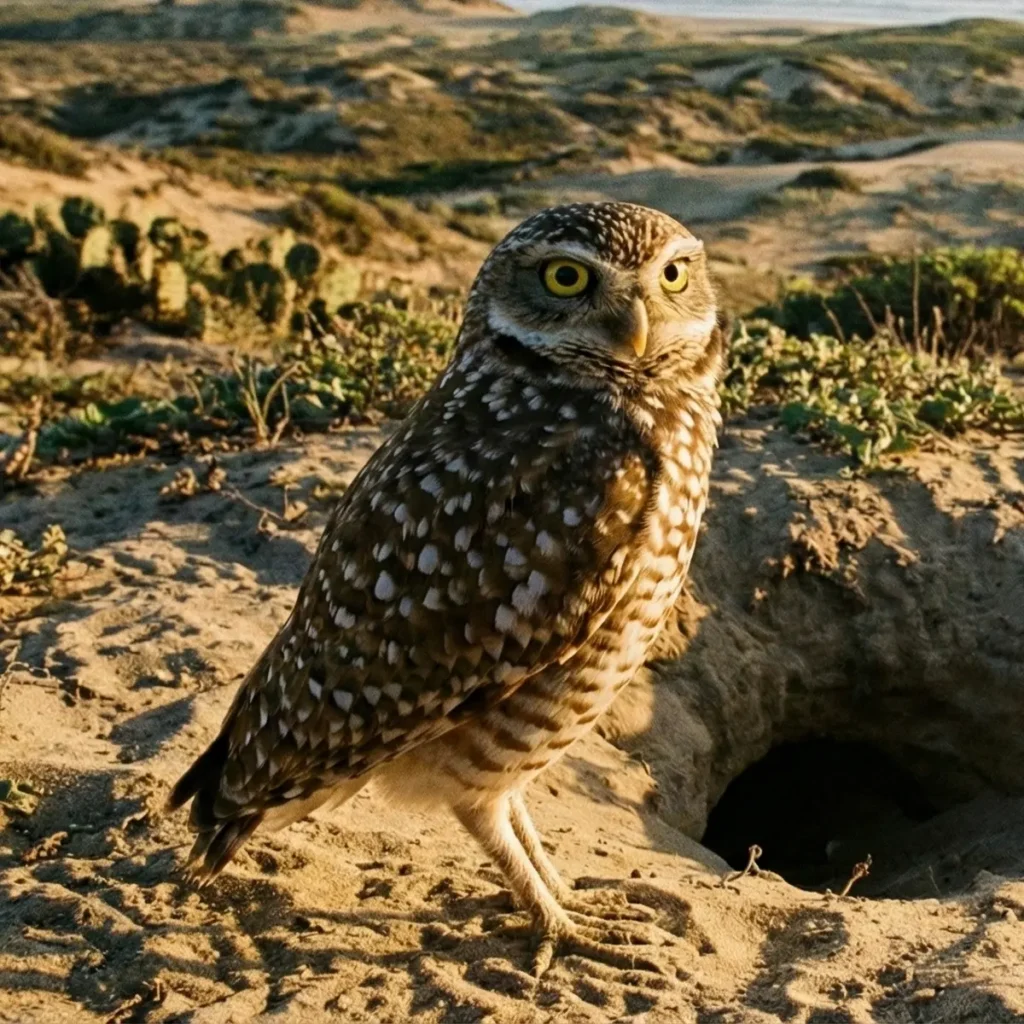
Finally, we descend to the coast. The Peruvian desert is a harsh environment, yet it holds a stark beauty. Here, among the ruins of ancient civilizations, lives one of the prettiest Peruvian birds, the Burrowing Owl (Athene cunicularia).
The Sentinel of History
Unlike its forest cousins, this owl is terrestrial. It stands guard on mounds of sand, its yellow eyes scanning the horizon. There is a profound connection here between culture and nature.
Often, you will find these Peruvian birds nesting within the archaeological complexes of the pre-Inca cultures. They are the modern guardians of the huacas (sacred shrines). To see a Burrowing Owl perched on an adobe wall that is 1,500 years old is to see the continuity of life in the desert.
Lima’s Hidden Gem
One does not need to travel far to see them. Exclusive golf clubs in Lima and the gardens of luxury hotels often host families of these owls. However, a private tour of the Pachacamac ruins offers a more atmospheric encounter.
Combined with a culinary tour of Lima—the gastronomic capital of South America—spotting the Burrowing Owl adds a layer of natural history to a city trip. It is a reminder that even in the driest deserts, life finds a way to flourish.
The Architecture of a Luxury Birding Trip
Planning a trip focused on Peruvian birds requires more than just booking a flight. It requires a choreography of logistics to ensure seamless movement between these diverse ecosystems.
The Private Charter Advantage
Peru is vast. To maximize your time and comfort, private aviation is essential. Jumping from the coast to the Andes and then to the Amazon by private plane turns days of travel into hours. It allows you to have breakfast watching seabirds in Lima and dinner listening to owls in the Amazon, covering the habitats of countless Peruvian birds in one day.
The Role of the Specialist Guide
In the world of luxury birding, the guide is your greatest asset. You do not want a generalist. You want an ornithologist, someone who has dedicated their life to the study of Peruvian birds.
Top-tier travel designers can secure the services of Peru’s leading biologists. These experts do not just identify birds; they interpret the landscape. They can mimic calls, spot a hummingbird from a hundred yards away, and explain the complex ecological web you are walking through.
Optics and Gear
For the elite traveler, the equipment must match the experience. If you are not traveling with your own, premium lodges often provide top-of-the-line Swarovski or Zeiss binoculars.
Photography is also a key component. Many luxury tours now offer “photo safaris” with professional wildlife photographers who teach you how to capture the perfect image of a hummingbird in flight or a macaw in the clay lick. Capturing images of Peruvian birds has become a highly sought-after artistic endeavor.
Conservation: The Ultimate Luxury
There is a growing recognition among the global elite that the greatest luxury is the ability to protect what we love. The habitats of Peruvian birds are fragile. The Amazon faces threats from deforestation; the glaciers of the Andes are retreating.
Philanthropic Travel
Many of the high-end lodges in Peru were founded with conservation at their core. By staying at these properties, you are directly funding the protection of the land.
However, the modern luxury traveler often goes further. “Conservation safaris” allow you to participate in scientific research. You might assist in checking nest boxes for macaws or monitoring the population of the Marvelous Spatuletail.
This deepens the connection to the destination. You are no longer just a passive observer of Peruvian birds; you become a patron of their survival. It provides a sense of purpose that transcends the typical vacation.
The Seasons of Flight
When should one visit? Peru is a year-round destination, but for the bird enthusiast, nuance matters.
- The Amazon: The dry season (May to October) is ideal for clay licks, as the birds are more active and the trails are less muddy.
- The Andes: The dry season offers clear blue skies, perfect for spotting condors and flamingos.
- The Coast: The Peruvian summer (December to March) is warmer, but the coastal mist (garúa) of the winter creates a mystical atmosphere in the desert reserves.
Your travel designer will curate the itinerary based on the specific Peruvian birds you wish to see, ensuring that you are in the right place at the peak of activity.
A Symphony of the Senses
Ultimately, a journey to see the birds of Peru is a sensory awakening. It is the smell of wet earth in the cloud forest. It is the biting cold wind on your face at the Condor’s cross. It is the taste of a Pisco Sour after a long day of trekking.
But mostly, it is the visual feast. The iridescent purple of a hummingbird’s throat. The shocking red of a macaw’s wing. The deep, abyssal black of a condor’s feather.
These colors stay with you. They are the souvenirs that cannot be bought in a shop. They are burned into your memory, reminders of a world that is wild, vibrant, and utterly magnificent.
Conclusion: An Invitation to the Extraordinary
The world is full of travel destinations, but few offer the profound biological richness of Peru. The Peruvian birds are more than just animals; they are the spirit of the landscape made visible.
They are the guardians of the skies, the witnesses to history, and the jewels of the wilderness. To seek them out is to engage in a pursuit that is intellectual, aesthetic, and deeply emotional.
Whether you are watching the frenetic dance of the Cock-of-the-rock or the silent vigil of the Burrowing Owl, you are participating in a ritual that connects you to the pulse of the planet.
Peru awaits. The lodges are prepared, the guides are ready, and the skies are teeming with life.
Are you ready to elevate your travel experience?
BLOG HOME