
The true essence of luxury travel lies not merely in the thread count of your linens or the vintage of the wine poured at dinner, but in the depth of understanding one acquires of a destination. Cusco, the Navel of the World, is a city often defined by its exterior majesty—the cyclopean walls, the terracotta roofs, and the verdant embrace of the Sacred Valley. Yet, for the intellectual voyager, the true richness of the Imperial City is interior. It is found within the curated halls, the hushed cloisters, and the private galleries that make up the circuit of museums in Cusco.
To visit the ancient capital of the Incas without engaging with its scholarly archives is to view a masterpiece through a veil. The museums in Cusco are not simply repositories of broken pottery; they are the vaulted memory banks of a civilization that defied the impossible. They narrate the collision of empires, the fusion of cosmologies, and the enduring spirit of the Andean people.
This dossier serves as a bespoke invitation to the high-net-worth traveler. We invite you to step off the cobblestones and into the sanctums of history, curating a journey through the finest museums in Cusco that offers acclimatization for the body and immense expansion for the mind.
The Philosophy of Slow Travel: Acclimatization as an Art Form
Upon arrival in Cusco, perched at a breathless 11,152 feet above sea level, the standard advice is rest. However, for the active intellect, stagnation is unappealing. This physiological necessity creates a unique opportunity to embrace the “Slow Travel” ethos. The most sophisticated way to adjust to the Andean altitude is not to sleep, but to wander slowly through the cool, oxygen-rich courtyards of the city’s cultural institutions.
A tour of museums in Cusco serves as the perfect physiological bridge. It allows for gentle movement, keeping the blood flowing without straining the heart, while simultaneously preparing the imagination for the archaeological wonders to follow. Before you stand before the sheer granite of Sacsayhuamán, you must understand the society that moved it. Before you board the Hiram Bingham train to Machu Picchu, you must grasp the religious fervor that built it. The museums in Cusco provide this essential prologue, transforming a vacation into a coherent narrative.
The Curatorial Big Five: A Deep Dive into Andean Heritage
While the city is dotted with various galleries, five institutions distinguish themselves through the provenance of their collections and the architectural splendor of their settings. These are the pillars of culture that every discerning traveler must visit.
1. The Museo Inka: The Imperial Standard
Housed within the palatial grandeur of the Casona del Almirante, the Museo Inka is arguably the most significant of all museums in Cusco. The building itself is a lesson in power dynamics. Constructed in the early 17th century by Admiral Francisco Aldrete y Maldonado, it sits arrogantly atop Inca walls, its Baroque façade and plateresque details signaling the dominance of the Spanish Crown.
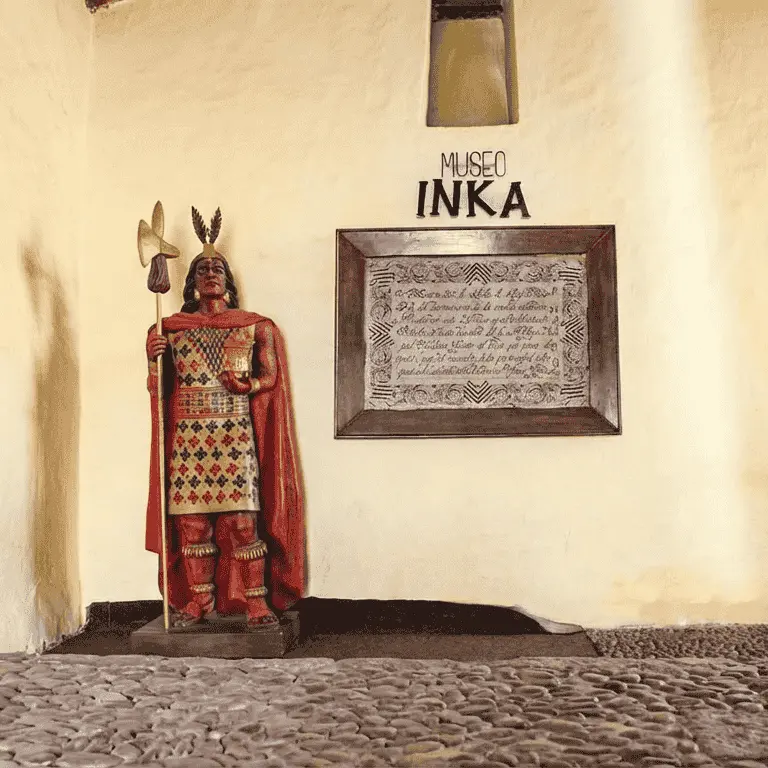
However, inside, the narrative is reclaimed. Unlike other museums in Cusco, the Museo Inka (administered by the National University of San Antonio Abad) provides a complete chronological sweep.
- Pre-Inca Context: The elite traveler understands that the Incas did not appear in a vacuum. Displays of Chanapata and Marcavalle ceramics reveal the thousands of years of cultural evolution that preceded the Empire.
- The Hall of Kings: The collection includes a mesmerizing array of Keros. These ceremonial wooden goblets, painted with intricate iconography, were key to political reciprocity and ritual drinking. They remain some of the finest examples of pre-Columbian art in existence.
- The Ancestral Presence: Perhaps the most arresting exhibit is the collection of mummies. In Inca belief, the dead were active members of society. Seeing the preservation techniques and the evidence of cranial trepanation (ancient neurosurgery) offers a visceral connection to the past that no textbook can replicate.
2. The Regional Historical Museum: The Home of the Literary Inca
Located in the bounding arches of the Casa Garcilaso, this institution holds a romantic allure distinct among museums in Cusco. This was the childhood home of Inca Garcilaso de la Vega, the son of a Spanish captain and an Inca royal. He became the first famous mestizo writer, and his home reflects that duality.
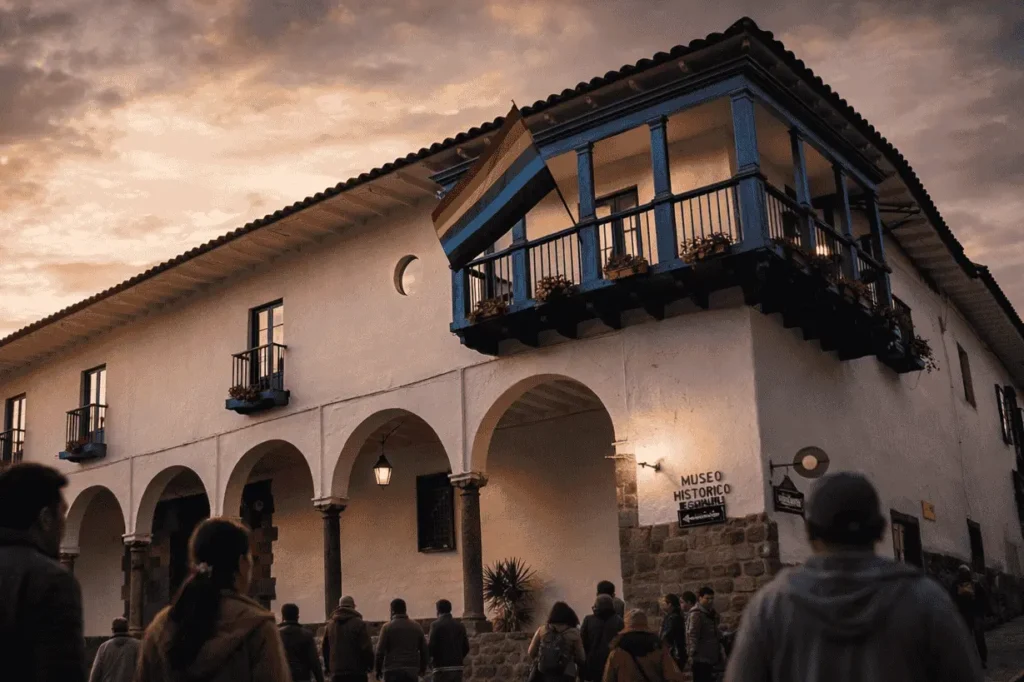
For the art collector, this museum is a pilgrimage site. It houses a definitive collection of the Escuela Cusqueña (Cusco School of Art). This artistic movement is a fascinating study in subversion. Indigenous artists, forced to paint Catholic imagery, subtly inserted their own deities into the canvases.
- Syncretism in Oil: Look closely at the depictions of the Virgin Mary; her robes often form the triangular shape of a mountain (Apu), merging the Catholic icon with the Andean earth mother (Pachamama).
- The Last Supper: Famous renditions often feature a roasted cuy (guinea pig) on the table instead of bread and lamb, grounding the biblical event in the Andean reality.
- Revolutionary Echoes: The museum also dedicates significant space to Tupac Amaru II, the indigenous revolutionary. Viewing his portraits adds a layer of political depth to your tour of museums in Cusco, highlighting the region’s fierce independence.
3. The Qoricancha Site Museum: Beneath the Golden Courtyard
The Qoricancha (Golden Enclosure) was the Vatican of the Inca Empire, a temple where walls were once sheathed in solid gold. While the Dominican Convent built above it is spectacular, the site museum located underground offers a different perspective. It is the scientific anchor among museums in Cusco.
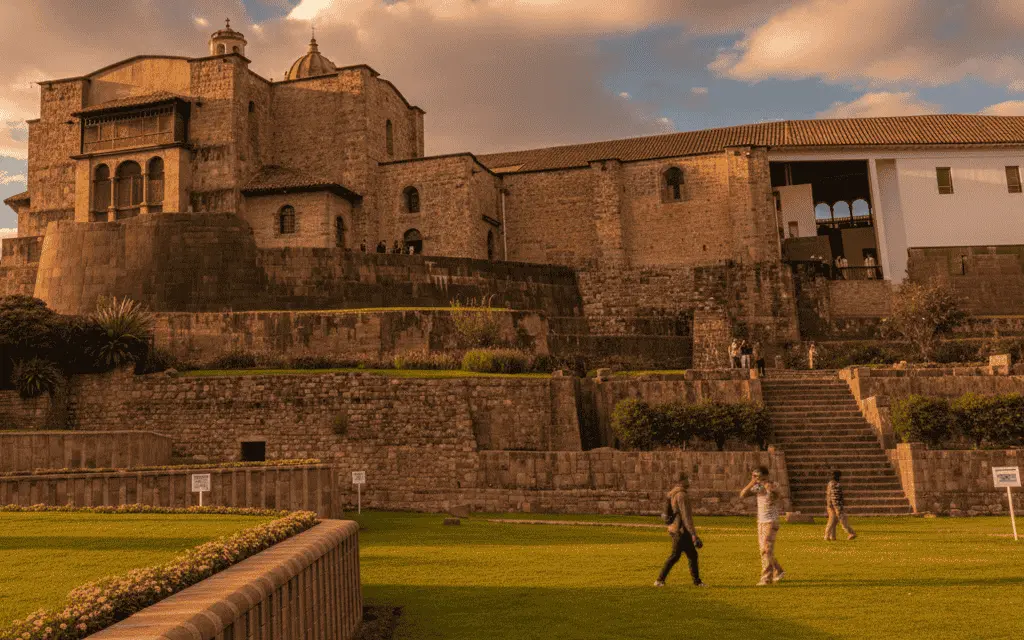
This space is for the traveler fascinated by engineering and lithic technology.
- The Science of Stone: Exhibits here analyze the chemical composition of the diorite and andesite stones used in the temple. You will learn about the hematite tools and the abrasive sands used to achieve a polish so fine it feels like glass.
- Cosmological Alignment: The museum explains the Ceque system—a series of invisible ritual lines that radiated from the Qoricancha to hundreds of huacas (shrines) across the empire. Understanding this transforms your view of the city; you realize you are walking through a giant celestial calendar.
- Offerings of Empire: Displays include recovered offerings of Spondylus shell. Imported from Ecuador, these shells were considered more valuable than gold, symbolizing rain and fertility.
4. The Museum of Popular Art: The Collector’s Secret
While many museums in Cusco focus on the ancient past, the Museum of Popular Art (Museo de Arte Popular) celebrates the living soul of the Andes. Run by the American Institute of Art, this venue is often overlooked by mass tourism, making it a quiet haven for the connoisseur of folk art.
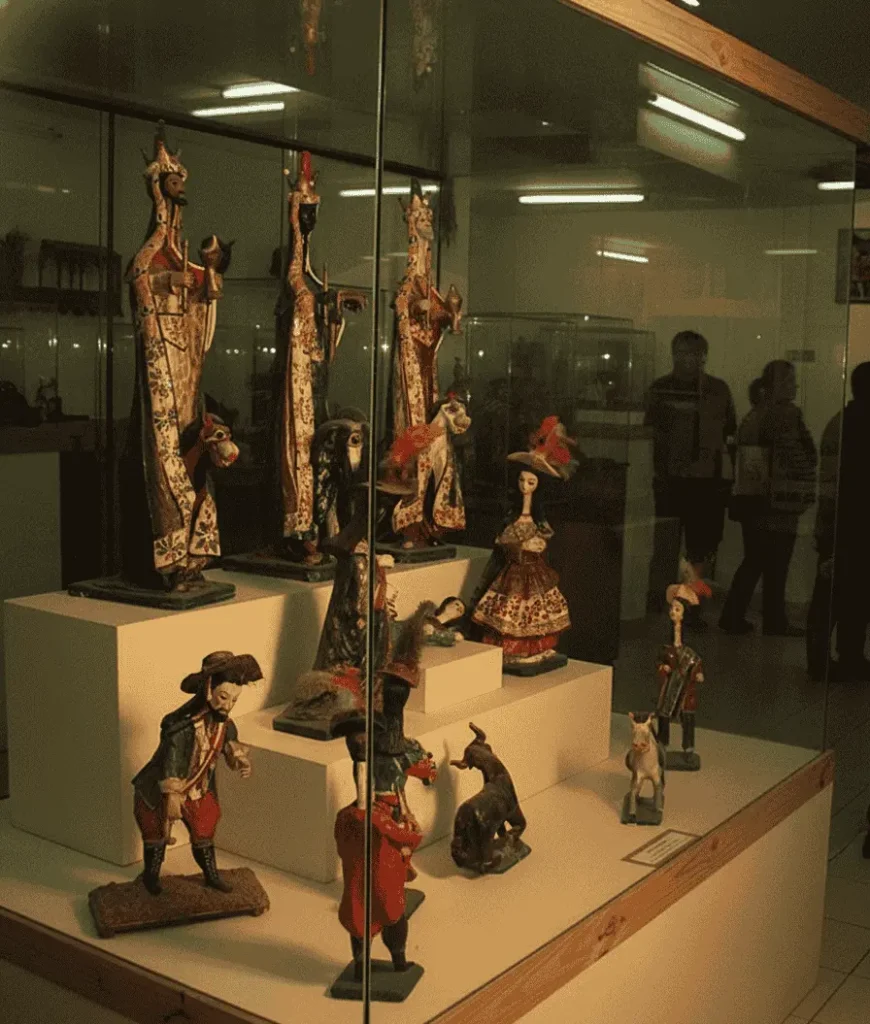
For the luxury traveler looking to acquire authentic pieces for their private collection, this museum serves as a masterclass in what to look for.
- The Mendívil Aesthetic: The museum holds premier examples of Hilario Mendívil’s work. His religious sculptures, characterized by distinctively elongated necks, are iconic to Cusco. Seeing the originals here trains the eye to distinguish between high-quality craftsmanship and tourist replicas found in markets.
- The Grotesque and the Divine: The collection of dance masks is visually stunning. These masks, used in festivals like the Virgin of Carmen, depict everything from demons to caricatures of Spanish colonial officials. They represent the satirical wit and resilience of the indigenous population, a narrative thread vital to the tapestry of museums in Cusco.
5. The Museum of Contemporary Art: The Modern Lens
To complete the circuit, one must engage with the present. The Museum of Contemporary Art, situated in the Municipal Palace at the Regocijo Plaza, offers a necessary counterpoint to the antiquity found in other museums in Cusco.
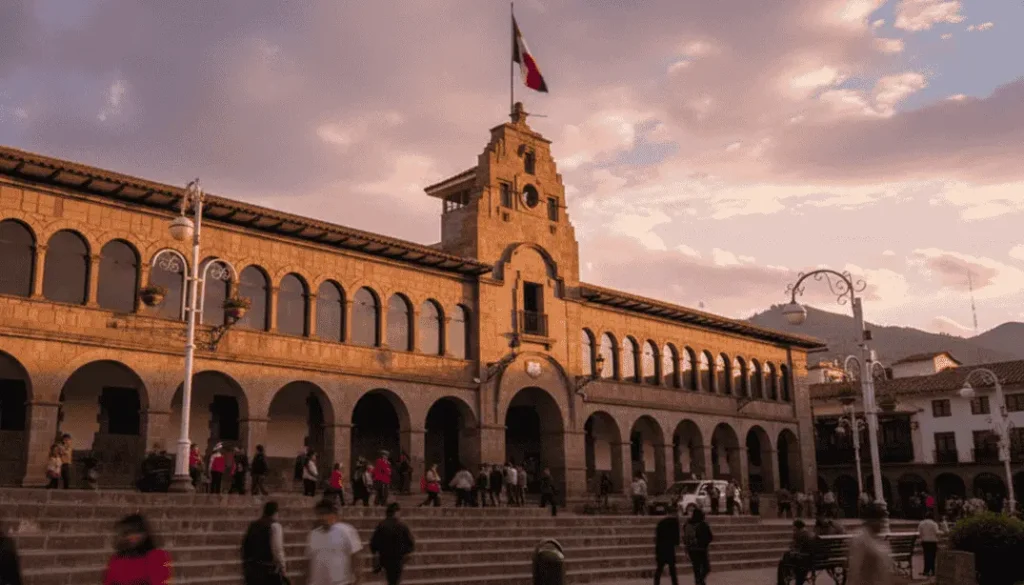
Here, the focus shifts to how modern Peruvian and international artists interpret the Andean legacy.
- Abstracting the Andes: You will find works that deconstruct Inca motifs into abstract forms, offering a fresh visual language.
- Political Commentary: Contemporary art often tackles the complexities of modern Peru—migration, identity, and globalization.
- A Quiet Refuge: This museum is rarely crowded. It offers a meditative space to sit with art that challenges the romanticized version of history, proving that Cusco is a dynamic, evolving city, not just a relic.
The Logistics of Luxury: Curating Your Experience
Navigating the museums in Cusco requires a strategy that prioritizes comfort, privacy, and exclusivity. The elite traveler does not stand in lines, nor do they rush.
The Boleto Turístico: Your Key to the City
Your concierge should secure the Boleto Turístico del Cusco (BTC) in advance. This is not merely a ticket; it is an all-access pass to the most prestigious cultural sites. It covers the Regional Historical Museum, the Museum of Contemporary Art, the Museum of Popular Art, and the Qoricancha Site Museum (note: the convent requires a separate entry). Holding this ticket ensures a seamless flow from one venue to the next, essential for a dignified tour of museums in Cusco.
The Necessity of Private Expertise
While the artifacts are visually stunning, their stories are complex. The plaques in museums in Cusco are often brief. We strongly recommend retaining a private specialist—a historian, an archaeologist, or an anthropologist—rather than a standard tour guide. A specialist can weave a narrative that connects the mummies in the Inca Museum to the paintings in the Casa Garcilaso, creating a graduate-level seminar tailored to your interests.
Strategic Timing
Crowd management is the hallmark of luxury travel. The museums in Cusco can become congested with large tour groups, particularly in the mid-morning.
- The Lunch Lull: The optimal time to visit is between 1:00 PM and 2:30 PM. As the large groups retire for lunch, the halls of the Admiral’s Palace empty out. You can enjoy the art in silence.
- Sunday Planning: Be aware that opening hours can fluctuate on weekends. Your itinerary designer should verify all times the morning of your visit.
A Bespoke Itinerary: The Intellectual’s Day in Cusco
For the traveler who wishes to dedicate a full day to the cultural immersion of museums in Cusco, we suggest the following itinerary. This route minimizes physical strain while maximizing historical engagement.
09:30 AM | The Pre-Columbian Foundation Begin your day at the Museo Inka. The morning light filtering into the colonial courtyard provides a stunning backdrop for photography. Spend ninety minutes here absorbing the scope of the empire. It is the most comprehensive of the museums in Cusco, setting the stage for everything else.
11:00 AM | The Colonial Transition A short, flat walk brings you to the Regional Historical Museum (Casa Garcilaso). Here, you witness the violent and artistic collision of Europe and the Andes. Focus on the paintings of the Cusco School.
12:30 PM | The Modern Interlude Cross the Plaza Regocijo to the Museum of Contemporary Art. Spend thirty minutes here to cleanse the visual palette with modern aesthetics. It serves as a refreshing break from the weight of history.
01:30 PM | The Gastronomic Pause Retire to a balcony table at Cicciolina or MAP Café for a leisurely lunch. Discuss the morning’s findings over sophisticated Andean cuisine.
03:30 PM | The Artistic Detail Stroll down Avenida El Sol to the Museum of Popular Art. This visit can be brief but focused. Look for the nuance in the ceramics and masks. It is a lighter, more whimsical stop among the museums in Cusco.
04:30 PM | The Golden Sunset Conclude at the Qoricancha Site Museum. After viewing the underground exhibits, ascend to the gardens of the convent. Watching the sun set against the curved black granite of the Inca apse is a spiritual experience. It is the perfect finale to your exploration of museums in Cusco.
Architecture as Artifact: The Walls Speak
It is vital to recognize that when visiting museums in Cusco, the structures themselves are primary exhibits. In Cusco, architecture is a palimpsest—layers of history written one over the other.
- The Casa del Almirante: Notice the corner window with its plateresque detailing. It is a rare example of colonial ostentation.
- The Casa Garcilaso: The wide arches and spacious patios reflect the Andalusian influence, yet the foundations are unmistakably Inca.
These buildings have survived centuries of earthquakes that leveled modern concrete structures. They stand as testaments to the symbiotic (and parasitic) relationship between the Inca mason and the Spanish architect. The atmosphere inside these museums in Cusco—the scent of cedar wood, the chill of ancient stone, the echo of footsteps—creates a sensory memory that is as valuable as the artifacts themselves.
Beyond the Circuit: The Living Museums
While the five institutions detailed above form the core curriculum, the sophisticated traveler understands that the distinction between “museum” and “city” in Cusco is porous. The Cathedral Basilica on the Plaza de Armas, though an active place of worship, holds a collection of gold, silver, and cedar carvings that rivals many European collections. It acts as an extension of the museums in Cusco.
Furthermore, the streets themselves, particularly the pedestrian alleyways of San Blas, are open-air galleries. Here, the descendants of the artists featured in the Museum of Popular Art continue to create. Visiting their ateliers offers a continuity of narrative that brings the history of museums in Cusco into the present day.
Conclusion: The Intellectual Souvenir
Travel to the Andes is often marketed as an adventure of the body—hiking the trail, climbing the peak, rafting the river. Yet, the greatest adventure Cusco offers is that of the mind. By prioritizing the museums in Cusco, you elevate your journey from a sightseeing trip to an anthropological expedition.
You gain more than just photographs; you gain context. You learn to see the landscape not just as scenery, but as the stage for one of humanity’s greatest dramas. The artifacts housed within the museums in Cusco—from the humblest ceramic pot to the most intricate golden idol—hold the keys to understanding the resilience, the genius, and the soul of the Andean people. For the elite traveler, this understanding is the ultimate luxury.
BLOG HOME: